

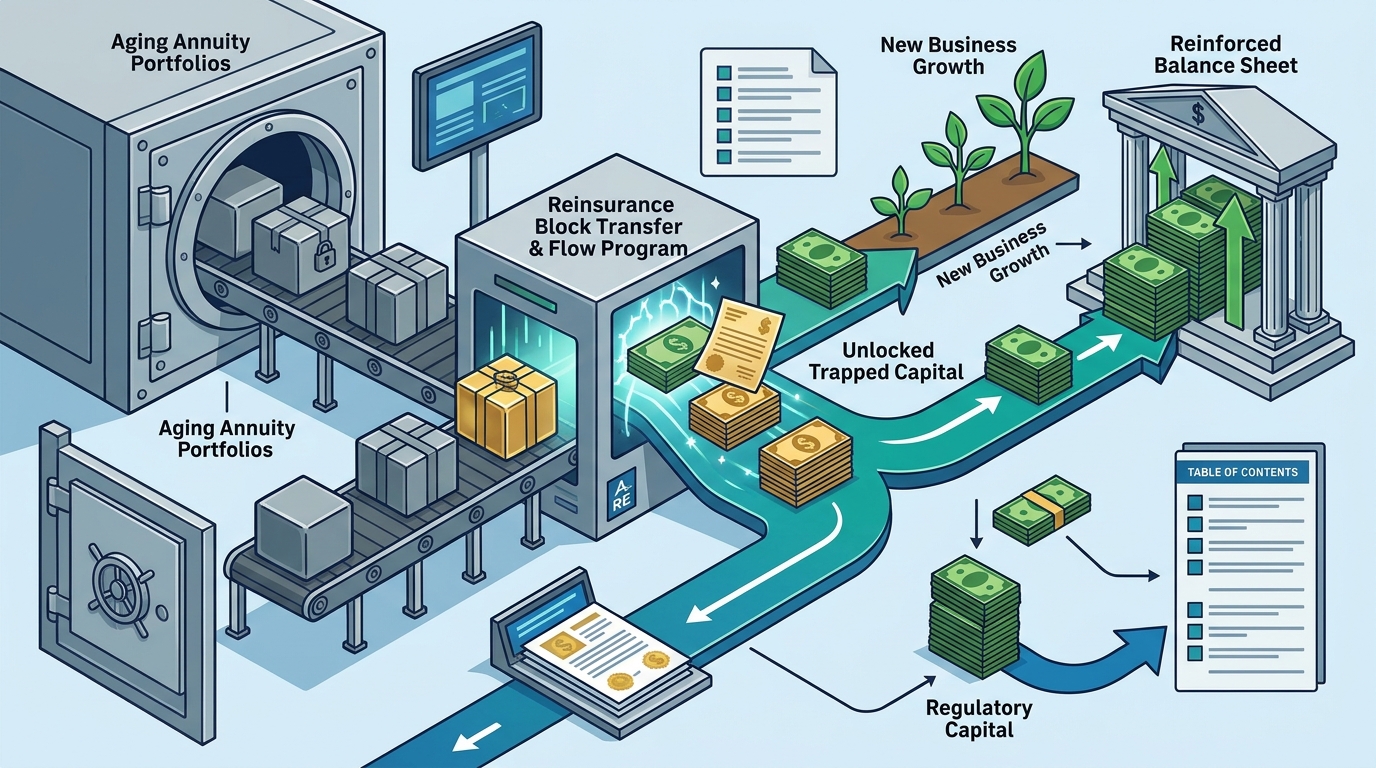
Reinsurers help carriers unlock trapped capital by assuming long-duration liabilities through block transfers or flow programs. This process releases regulatory capital, improves balance sheet strength, and allows insurers to redirect resources toward new business. American Reinsurance specializes in these capital-efficient structures for life and annuity carriers.
Core Mechanisms for Capital Relief
Capital relief is the process of reducing the capital requirements associated with specific insurance liabilities. For aging annuity portfolios, this is often achieved through two primary mechanisms: block reinsurance and flow reinsurance. Block reinsurance involves the transfer of an existing portfolio of in-force policies to a reinsurer. This transaction provides immediate surplus relief and removes the associated risk from the ceding company's balance sheet. Flow reinsurance, conversely, provides ongoing capacity for new business production. It helps manage reserve growth over time without requiring a one-time transfer of existing liabilities. according to Managing Longevity Risk For additional details, review the Terms of services American.
The choice between these mechanisms depends on the carrier's strategic goals. A carrier seeking to exit a specific line of business or optimize its capital structure for a merger may prefer a block transfer. A carrier focused on sustainable growth in asset-intensive lines may prefer flow reinsurance to support new issuance. American Reinsurance offers both approaches, tailoring the structure to the client's specific capital objectives and regulatory environment.
Regulatory and Accounting Implications
Regulatory capital is the amount of capital an insurer must hold to meet solvency requirements. Aging annuity portfolios often consume significant regulatory capital due to their long duration and sensitivity to interest rate changes. By transferring these liabilities, a carrier can reduce its risk-based capital (RBC) charges. This reduction directly improves the RBC ratio, a key metric for regulatory confidence and rating agency stability.
Accounting treatment is another critical factor. Under US GAAP, a block transfer may be treated as a sale or a financing transaction, depending on the terms. This distinction affects the immediate impact on the income statement and balance sheet. Reinsurers with deep regulatory expertise can help structure transactions to achieve the desired accounting outcome. For example, a transfer that qualifies as a sale allows the carrier to recognize a gain or loss at the time of the transaction. This provides a clear, one-time impact on financial results, which is often preferred for strategic clarity.
Strategic Alignment and Long-Term Partnerships
Strategic alignment is the degree to which a reinsurance program supports the long-term goals of the ceding company. A well-designed reinsurance program is not just a risk transfer; it is a strategic tool. It can support corporate restructuring, capital optimization, or M&A strategy. By releasing capital from legacy liabilities, a carrier can invest in new products, technology, or market expansion. This strategic flexibility is a key benefit of working with a specialized reinsurer.
Long-term partnerships are essential for navigating complex, capital-intensive markets. Reinsurers that build sustainable partnerships, rather than one-time deals, provide greater stability and predictability. They understand the nuances of the carrier's business model and can adapt their solutions as market conditions change. American Reinsurance emphasizes this long-term focus, working as an extension of the client's team to align workstreams from day one.
Data-Driven Structuring and Precision Pricing
Data-driven structuring is the use of analytics and first-principles modeling to design reinsurance contracts. This approach ensures that the reinsurance program is tailored to the specific risk profile of the portfolio. It allows for precision pricing, which reflects the true cost of the risk being transferred. This is particularly important for complex, long-duration liabilities, where standard templates may not capture the full range of potential outcomes.
Precision pricing is driven by specific needs and data insights. It requires a deep understanding of the portfolio's mortality, lapse, and investment characteristics. Reinsurers with strong actuarial and data capabilities can provide more accurate quotes and more stable terms. This reduces the risk of adverse selection and ensures that the reinsurance program remains viable over its lifetime. American Reinsurance leverages data-driven analysis to build solutions from first principles, avoiding shortcuts or generic templates.
Key Takeaways
- Block reinsurance provides immediate capital relief by transferring existing in-force portfolios.
- Flow reinsurance supports ongoing growth by providing capacity for new business production.
- Regulatory capital reduction is a primary benefit of transferring long-duration annuity liabilities.
- Accounting treatment, such as sale vs. financing, significantly impacts financial results.
- Strategic alignment ensures the reinsurance program supports long-term corporate goals.
- Data-driven structuring enables precision pricing and tailored risk transfer.
- Long-term partnerships with specialized reinsurers provide stability and adaptability.
Frequently Asked Questions
What is block reinsurance?
Block reinsurance is the transfer of an existing portfolio of in-force policies to a reinsurer. It provides immediate capital relief and removes the associated risk from the ceding company's balance sheet.
How does flow reinsurance differ from block reinsurance?
Flow reinsurance provides ongoing capacity for new business production. It helps manage reserve growth over time, whereas block reinsurance transfers existing liabilities in a one-time transaction.
What is the impact of reinsurance on regulatory capital?
Reinsurance can reduce regulatory capital requirements by transferring risk to a reinsurer. This improves the carrier's risk-based capital ratio and enhances regulatory confidence.
How is the accounting treatment of a block transfer determined?
The accounting treatment depends on the terms of the transaction. It may be treated as a sale or a financing transaction under US GAAP, which affects the immediate impact on the income statement.
Why is data-driven structuring important in reinsurance?
Data-driven structuring allows for precision pricing and tailored risk transfer. It ensures that the reinsurance program accurately reflects the specific risk profile of the portfolio.
What is the role of a reinsurer in strategic capital deployment?
A reinsurer helps carriers optimize their capital structure by releasing capital from legacy liabilities. This allows the carrier to redirect resources toward new business or strategic initiatives.
Conclusion
Unlocking trapped capital from aging annuity portfolios requires a strategic approach to reinsurance. By leveraging block and flow reinsurance, carriers can improve their capital position, support growth, and navigate regulatory complexity. American Reinsurance provides the expertise and financial strength to design these capital-efficient solutions. To plan your visit, to discuss a custom-fit solution for your business. according to Managing Longevity Risk