

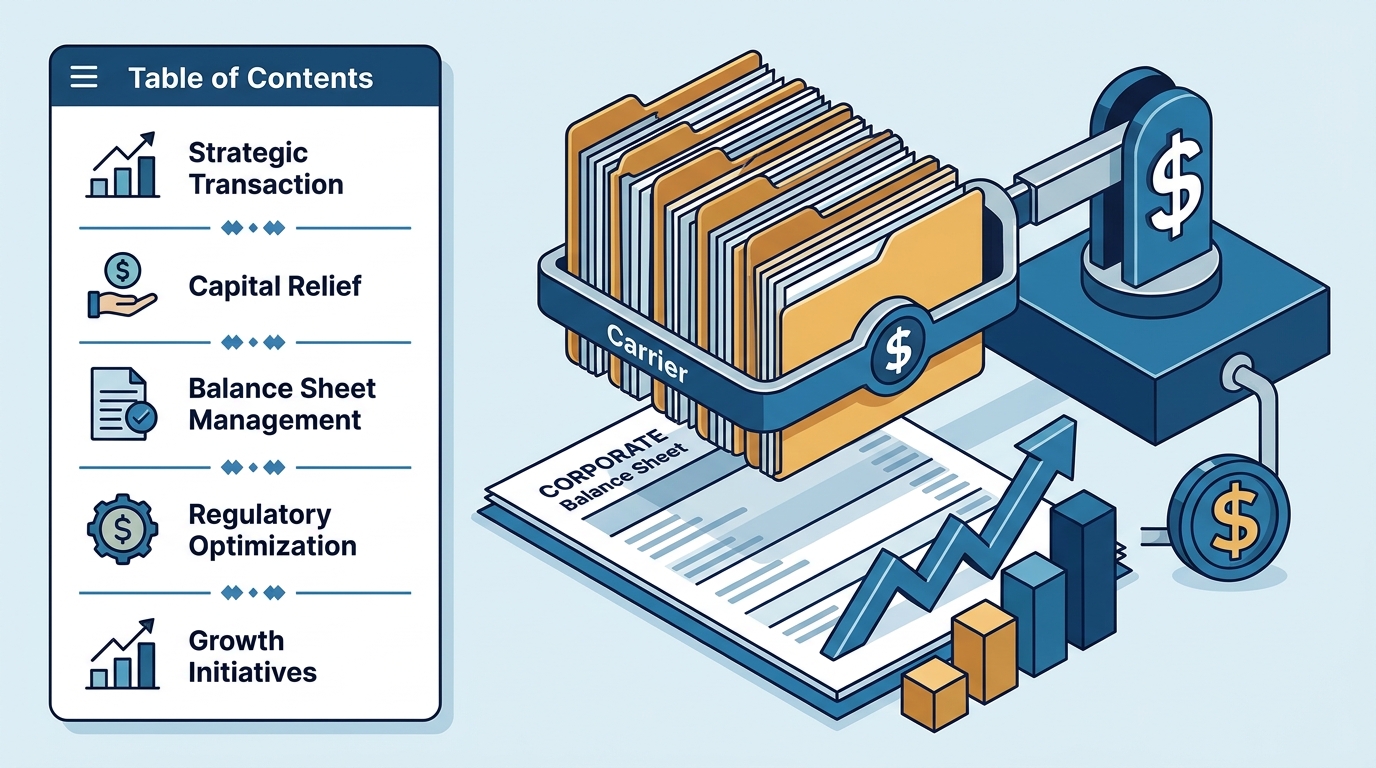
Block reinsurance is a strategic transaction that transfers an entire in-force portfolio of policies to a reinsurer in exchange for a lump sum payment. For insurance carriers, this strategy provides immediate capital relief, simplifies balance sheet management, and allows leadership to pivot toward new growth initiatives without the drag of legacy liabilities. By offloading long-duration risks, carriers can optimize their capital structure and improve regulatory ratios, creating a more agile and financially resilient organization.
Understanding Capital Relief and Balance Sheet Optimization
The primary driver for block reinsurance is the immediate release of capital tied up in legacy reserves. When a carrier sells a block of business, the associated liabilities are removed from the balance sheet, and the resulting cash inflow strengthens the company's capital position. This is particularly critical for life and annuity carriers managing asset-intensive products where reserves grow over time. The impact on regulatory capital ratios can be significant, often allowing carriers to improve their Risk-Based Capital (RBC) ratios without raising new equity.
For example, a carrier holding a large block of fixed annuities may find that the reserves required to support these policies consume a disproportionate amount of their available capital. By transferring this block, the carrier converts illiquid reserve obligations into liquid capital. This shift not only improves solvency metrics but also enhances the company's credit profile, potentially lowering the cost of future borrowing or investment activities. The strategic implication is clear: block reinsurance is not just about risk transfer, but about optimizing the financial architecture of the firm.
Strategic Motives: M&A, Runoff, and Restructuring
Carriers pursue block reinsurance for various strategic reasons, including mergers and acquisitions (M&A), corporate restructuring, or the decision to exit a specific line of business. In an M&A scenario, a buyer may acquire a carrier specifically for its in-force block, while the seller uses the transaction to clean up its balance sheet. Alternatively, a carrier may choose to run off a legacy book of business, transferring it to a specialized reinsurer to focus on new business production.
A named entity example is the use of Special Purpose Vehicles (SPVs) in these transactions. Carriers often structure block deals through SPVs to isolate the transferred liabilities and manage tax and accounting implications. This structural flexibility allows for tailored solutions that align with the seller's specific corporate goals. The implication for carriers is that block reinsurance offers a versatile tool for corporate strategy, enabling them to reshape their portfolio to match their long-term vision.
Regulatory Implications and Compliance Considerations
Block reinsurance transactions are subject to strict regulatory oversight, particularly regarding the adequacy of the transfer and the financial strength of the reinsurer. Regulators, such as the National Association of Insurance Commissioners (NAIC), require that reinsurance agreements meet specific criteria to be recognized for capital relief. This includes ensuring that the risk transfer is genuine and that the reinsurer is sufficiently capitalized to honor its obligations.
Compliance with these regulations is essential to avoid penalties or the denial of capital credit. Carriers must work closely with their regulators to ensure that the transaction structure is transparent and that all necessary disclosures are made. The implication is that while block reinsurance offers significant benefits, it requires a high level of regulatory expertise and careful planning to execute successfully. Failure to navigate these complexities can result in delayed transactions or reduced capital relief.
Pricing Dynamics and Market Conditions
The pricing of block reinsurance is influenced by market conditions, interest rates, and the specific risk profile of the portfolio being transferred. In a low-interest-rate environment, the cost of reinsurance may be higher due to the increased present value of future liabilities. Conversely, in a rising-rate environment, the cost may decrease, making block transactions more attractive. Carriers must carefully time their transactions to maximize value. according to Reinsurance Regulation
Market conditions also affect the availability of capacity. During periods of high demand for reinsurance, carriers may face tighter terms and higher premiums. However, in a competitive market, carriers may be able to negotiate more favorable terms. The implication is that block reinsurance is a market-driven activity, and carriers must stay informed about industry trends to make informed decisions. Timing the market correctly can significantly impact the net proceeds from the transaction. according to Insurance and Reinsurance
Long-Term Partnerships and Risk Alignment
Successful block reinsurance transactions often involve long-term partnerships between the carrier and the reinsurer. These partnerships are built on trust, transparency, and a shared understanding of the risks involved. A strong partnership ensures that the transaction is executed smoothly and that both parties benefit from the arrangement. For carriers, this means choosing a reinsurer that is not only financially strong but also aligned with their strategic goals.
A concrete example is the use of bespoke reinsurance structures that align with the carrier's investment and corporate strategy. These structures can be designed to address unique product, investment, or liability characteristics, providing a tailored solution that standard reinsurance contracts cannot offer. The implication is that block reinsurance is not a one-size-fits-all solution; it requires a partner that can provide precision and flexibility. This alignment ensures that the transaction delivers the intended strategic benefits.
Key Takeaways
- Block reinsurance provides immediate capital relief by transferring in-force liabilities to a reinsurer.
- It is a strategic tool for M&A, restructuring, and exiting legacy lines of business.
- Regulatory compliance is critical to ensure capital credit and avoid penalties.
- Pricing is influenced by market conditions, interest rates, and portfolio risk profile. according to Tenure of the
- Long-term partnerships with aligned reinsurers enhance transaction success.
- Bespoke structures can address unique product and liability characteristics.
Frequently Asked Questions
What is the primary benefit of block reinsurance for insurance carriers?
The primary benefit is immediate capital relief, which improves regulatory capital ratios and strengthens the balance sheet.
How does block reinsurance differ from flow reinsurance?
Block reinsurance transfers an entire in-force portfolio in a single transaction, while flow reinsurance covers new business on an ongoing basis.
What are the regulatory requirements for block reinsurance?
Regulators require that the risk transfer is genuine and that the reinsurer is financially strong to ensure capital credit is granted.
How does interest rate affect block reinsurance pricing?
Interest rates influence the present value of future liabilities, which directly impacts the cost of reinsurance and the net proceeds from the transaction.
Can block reinsurance be used for M&A strategies?
Yes, block reinsurance is often used in M&A scenarios to clean up balance sheets or acquire specific in-force blocks.
What role do SPVs play in block reinsurance?
SPVs are used to isolate transferred liabilities and manage tax and accounting implications, providing structural flexibility.
Conclusion
Block reinsurance is a powerful tool for insurance carriers seeking to optimize their capital structure and strategic direction. By understanding the capital impact, regulatory implications, and market dynamics, carriers can make informed decisions that enhance their financial resilience and growth potential. to discuss how a tailored block reinsurance strategy can align with your specific corporate goals and regulatory environment. according to The Fed Accounting