

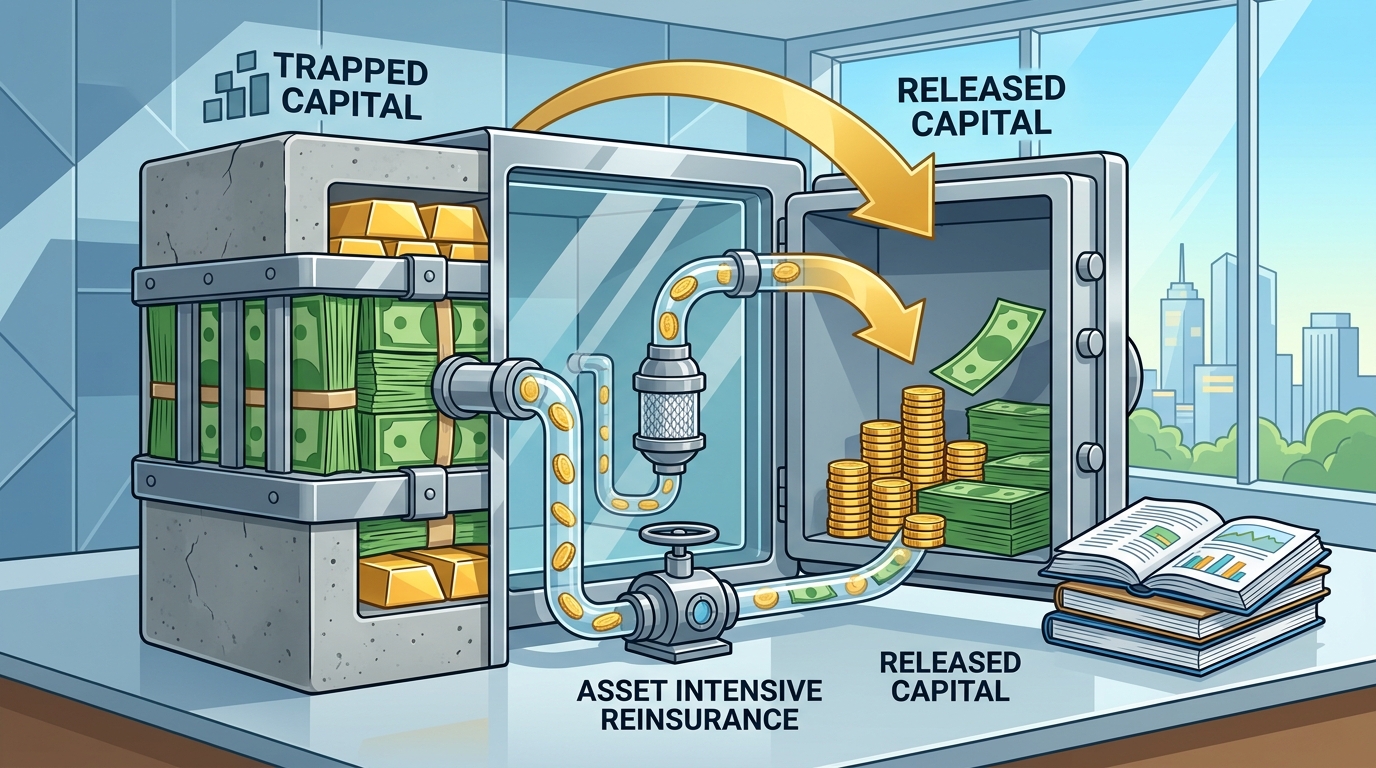
For life insurers managing asset-intensive lines of business, trapped capital is a primary barrier to growth and profitability. American Reinsurance provides strategic reinsurance solutions specifically designed to release this capital, allowing carriers to optimize their balance sheets and pursue new business opportunities with confidence. This guide explores how asset-intensive reinsurance, capital release strategies, and balance sheet optimization work together to transform a carrier's financial position.
Asset-Intensive Reinsurance
Asset-intensive reinsurance is a risk transfer mechanism where a ceding company transfers a portion of its long-duration liabilities to a reinsurer in exchange for capital relief. This type of reinsurance is critical for life and annuity carriers because these products require significant upfront capital to support future policyholder obligations. Unlike short-tail lines, the capital tied up in these liabilities can remain locked for decades, reducing the insurer's ability to deploy funds for growth or investment.
The Challenge of Long-Duration Liabilities
Life insurance and annuity products create complex, long-duration liabilities that require substantial capital reserves. As interest rates fluctuate and regulatory requirements evolve, the capital needed to support these liabilities can increase, trapping funds that could otherwise be used for strategic initiatives. American Reinsurance specializes in these complex liabilities, offering tailored solutions that align with a carrier's specific business model and capital objectives.
Why Standard Structures Fall Short
Standard reinsurance structures often fail to address the unique challenges of asset-intensive business. These structures may not provide sufficient capital relief or may not align with the carrier's long-term strategic goals. American Reinsurance takes a bespoke approach, building solutions from first principles and leveraging data-driven analytics to design structures that deliver true capital efficiency. This approach ensures that the reinsurance program is not just a short-term fix, but a long-term partnership that supports the carrier's growth and resilience.
Capital Release Strategies
Capital release strategies are financial techniques used by insurers to free up trapped capital from their balance sheets. These strategies can include reinsurance, securitization, and other risk transfer mechanisms. The goal is to reduce the capital required to support existing liabilities, thereby improving the insurer's capital position and enabling it to pursue new business opportunities.
Flow Reinsurance for Ongoing Growth
Flow reinsurance is a strategy that provides ongoing capacity for new business. By ceding a portion of new business to a reinsurer, a carrier can manage reserve growth while maintaining balance sheet strength and ratings stability. American Reinsurance offers flow reinsurance programs that integrate seamlessly with new issuance, allowing partners to grow confidently over time. This strategy is particularly effective for carriers looking to expand their business without compromising their capital position.
Block Reinsurance for Strategic Relief
Block reinsurance is a strategy that releases capital from legacy liabilities. This type of reinsurance is often used in situations where a carrier is undergoing corporate restructuring, capital optimization, or M&A strategy. American Reinsurance provides block reinsurance solutions that are tailored to closed blocks, runoff, or acquired portfolios. These transactions are structured to enhance financial flexibility while maintaining transparency and regulatory integrity, allowing carriers to unlock capital that would otherwise remain trapped in legacy business.
Balance Sheet Optimization
Balance sheet optimization is the process of improving the structure and efficiency of an insurer's balance sheet. This involves managing assets and liabilities to maximize capital efficiency, reduce risk, and support long-term growth. For life insurers, balance sheet optimization is a critical component of strategic planning, as it directly impacts the company's ability to meet regulatory requirements and pursue new business opportunities.
Aligning Reinsurance with Corporate Strategy
Effective balance sheet optimization requires aligning reinsurance strategies with overall corporate goals. American Reinsurance partners with clients to address unique product, investment, or liability characteristics, using reinsurance to reshape risk and optimize capital usage. This alignment ensures that the reinsurance program supports the carrier's strategic objectives, whether that involves expanding into new markets, improving profitability, or enhancing financial resilience.
The Role of Regulatory Expertise
Regulatory requirements play a significant role in balance sheet optimization. Different jurisdictions have different capital requirements and regulatory frameworks, which can impact the effectiveness of reinsurance strategies. American Reinsurance brings clarity to compliance in multiple jurisdictions, including NAIC, Solvency II, and APAC frameworks. This regulatory expertise ensures that reinsurance structures are not only effective but also compliant with local and international regulations, reducing the risk of regulatory penalties and enhancing the carrier's overall financial stability.
Key Takeaways
- Asset-intensive reinsurance is a critical tool for life insurers to release trapped capital from long-duration liabilities.
- Capital release strategies, such as flow and block reinsurance, can significantly improve a carrier's capital position and support growth.
- Balance sheet optimization requires aligning reinsurance strategies with overall corporate goals and regulatory requirements.
- American Reinsurance offers bespoke reinsurance solutions that are tailored to a carrier's specific business model and capital objectives.
- Regulatory expertise is essential for ensuring that reinsurance structures are compliant and effective across different jurisdictions.
- A long-term partnership with a strategic reinsurer can provide the capital support and risk management needed to navigate complex, capital-intensive markets.
Frequently Asked Questions
What is asset-intensive reinsurance?
Asset-intensive reinsurance is a risk transfer mechanism where a ceding company transfers a portion of its long-duration liabilities to a reinsurer in exchange for capital relief.
How does flow reinsurance support growth?
Flow reinsurance provides ongoing capacity for new business, allowing carriers to manage reserve growth while maintaining balance sheet strength and ratings stability.
What is block reinsurance used for?
Block reinsurance is used to release capital from legacy liabilities, often in situations involving corporate restructuring, capital optimization, or M&A strategy.
Why is balance sheet optimization important for life insurers?
Balance sheet optimization is important because it improves capital efficiency, reduces risk, and supports long-term growth, which are critical for life insurers managing complex, long-duration liabilities.
How does American Reinsurance approach reinsurance structuring?
American Reinsurance takes a bespoke approach, building solutions from first principles and leveraging data-driven analytics to design structures that deliver true capital efficiency.
What regulatory frameworks does American Reinsurance work with?
American Reinsurance is familiar with regulatory regimes across key global markets, including NAIC, Solvency II, and APAC frameworks.
Conclusion
Releasing trapped capital from asset-intensive lines of business is a critical challenge for life insurers. By leveraging strategic reinsurance solutions, carriers can optimize their balance sheets, improve capital efficiency, and support long-term growth. American Reinsurance is a strategic partner for insurers navigating these complex, capital-intensive markets, offering tailored, capital-backed solutions that empower carriers to grow with confidence. To discuss how a capital-efficient, custom-fit solution can benefit your business, .