

Reinsurance serves as the financial backbone for insurance carriers, allowing them to manage risk exposure and stabilize capital reserves. According to the Swiss Re Institute, global reinsurance premiums reached approximately $700 billion in recent years, highlighting the critical role this sector plays in the global economy. For primary insurers, choosing between block and flow reinsurance is not merely an accounting decision but a fundamental strategic pivot that dictates underwriting agility, capital efficiency, and long-term solvency. Understanding the mechanical differences between these two structures is essential for risk managers and executives navigating an increasingly volatile market. (Contact Us)
What Is Block Reinsurance?
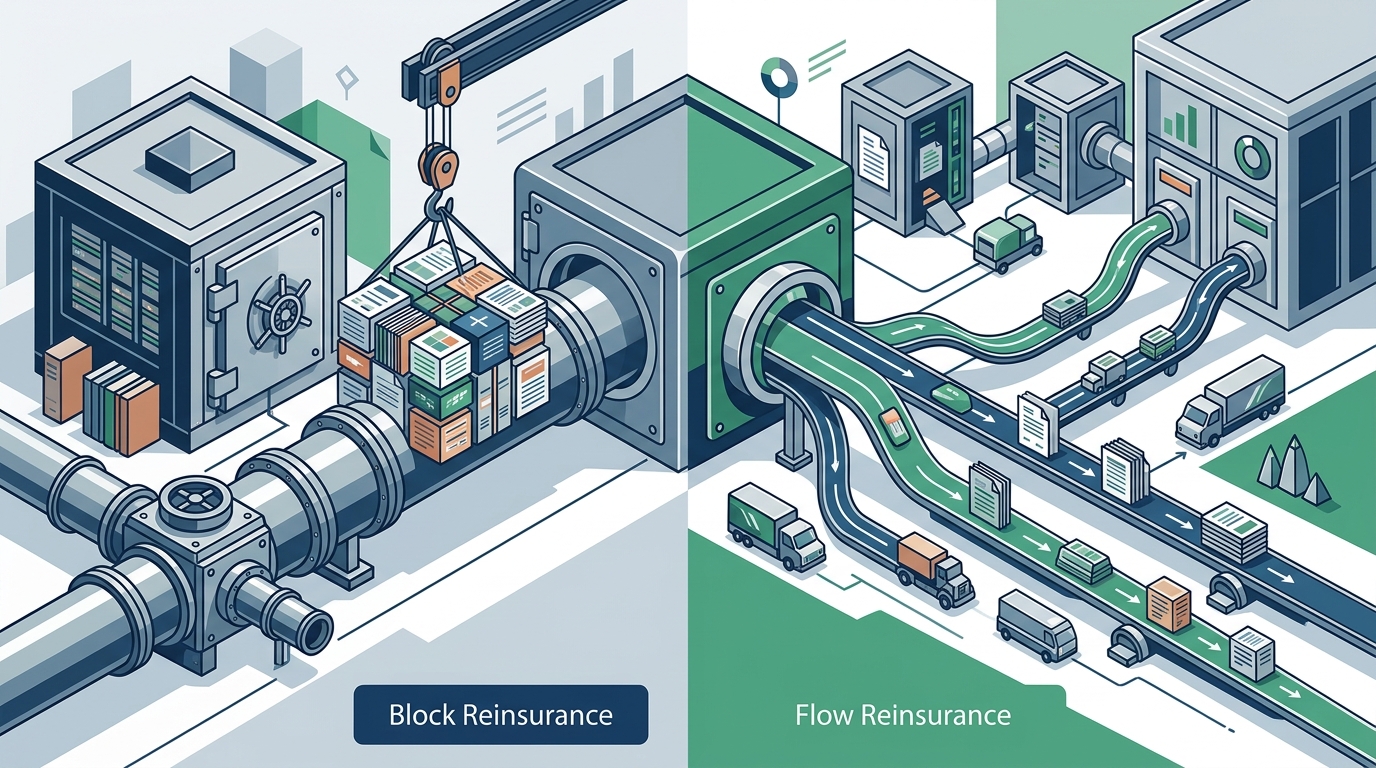
Block reinsurance is a facultative arrangement where an insurer cedes a specific, pre-defined portfolio of policies to a reinsurer. This structure is characterized by its static nature. The insurer selects a "block" of business, such as a group of commercial property policies or a specific line of casualty coverage, and transfers the risk entirely to the reinsurer for a set period. This is often referred to as a "block of business" transaction. (About)
The defining characteristic of block reinsurance is its exclusivity. Once the block is ceded, the primary insurer no longer retains any risk on those specific policies. This allows the insurer to immediately remove that risk from its balance sheet, freeing up capital for new underwriting opportunities. It is particularly useful for insurers looking to exit a specific market segment or manage a sudden spike in liability claims within a defined portfolio.
According to data from the Reinsurance Group of America, block transactions often involve larger, more complex risk transfers that require extensive due diligence. The reinsurer evaluates the historical loss experience of the specific block before agreeing to terms. This process ensures that the price reflects the true risk profile of the ceded business, providing the ceding company with certainty but at the cost of administrative flexibility.
What Is Flow Reinsurance?
Flow reinsurance, also known as automatic reinsurance, is a continuous, ongoing agreement that covers a broad category of new business written by the insurer. Unlike block reinsurance, which targets existing portfolios, flow reinsurance is forward-looking. It acts as a safety net for the insurer's daily underwriting activities, automatically ceding a portion of every new policy that falls within the agreed-upon parameters.
This structure is defined by its automaticity. The insurer does not need to submit individual risks for approval. As long as the policy meets the criteria set in the treaty (such as premium size, geographic location, or industry type), the risk is automatically shared with the reinsurer. This provides unparalleled operational efficiency, allowing insurers to write business at scale without being bogged down by repetitive administrative processes.
The Milliman Reinsurance Outlook highlights that flow treaties are the preferred mechanism for insurers seeking to smooth out underwriting cycles. By automatically spreading risk across a larger pool, insurers can maintain consistent capital ratios even during periods of high growth or unexpected loss events. This stability is crucial for maintaining rating agency scores and ensuring long-term solvency.
Key Differences in Structure and Flexibility
The choice between block and flow reinsurance hinges on the insurer's need for control versus the need for speed. Block reinsurance offers high control over which risks are transferred, allowing for precise risk selection. However, it lacks flexibility once the contract is signed. Any new risks or changes in the existing block require renegotiation or a new transaction.
Flow reinsurance, conversely, offers high flexibility but less granular control. The insurer must trust the treaty terms to cover the breadth of its business. While this reduces administrative burden, it also means the insurer cannot cherry-pick which risks to cede. Every policy within the treaty's scope is automatically included, regardless of individual risk quality.
Administrative Efficiency
Flow reinsurance significantly reduces the administrative workload for both the insurer and the reinsurer. There is no need for individual risk submissions, approvals, or continuous monitoring of specific policy details. This efficiency allows underwriters to focus on new business generation rather than risk management logistics.
Risk Selection Precision
Block reinsurance allows for precise risk selection. The insurer can choose to cede only the most volatile or high-severity risks, retaining the more profitable, stable policies. This targeted approach can optimize the overall risk profile of the remaining portfolio, but it requires sophisticated data analytics to identify which blocks are most suitable for cession.
Financial Implications and Capital Management
The financial impact of reinsurance structures extends beyond premium costs. It directly influences an insurer's capital requirements, profitability metrics, and strategic agility. Block reinsurance often results in a one-time capital release, providing immediate liquidity. This can be used to pay down debt, invest in technology, or fund new product lines.
Flow reinsurance, on the other hand, provides ongoing capital relief. By continuously ceding risk, the insurer maintains a stable capital base that grows in tandem with its business volume. This is particularly beneficial for insurers in high-growth phases, where rapid expansion could otherwise strain capital reserves.
According to the Casualty Actuarial Society, the cost of capital for insurers utilizing flow reinsurance is often lower due to the diversification benefits. The continuous spreading of risk reduces the volatility of loss ratios, leading to more predictable financial outcomes and potentially lower costs of capital from investors and rating agencies.
Strategic Selection: Which Model Fits Your Portfolio?
Selecting the right reinsurance model requires a deep understanding of the insurer's strategic goals, risk appetite, and operational capabilities. Block reinsurance is ideal for insurers looking to exit specific markets, manage large, discrete risk exposures, or achieve immediate capital relief. It is best suited for companies with strong analytical capabilities to identify and value specific blocks of business.
Flow reinsurance is optimal for insurers seeking operational efficiency, continuous capital stability, and support for rapid growth. It is particularly effective for companies with high volumes of homogeneous risks, such as personal lines or small commercial policies. The automatic nature of flow treaties allows these insurers to scale without proportional increases in administrative overhead.
Hybrid Approaches
Many modern insurers utilize a hybrid approach, combining elements of both block and flow reinsurance. For example, an insurer might use flow reinsurance for its core personal lines business while employing block reinsurance for specific, high-severity commercial lines. This tailored strategy maximizes the benefits of each model while mitigating their respective drawbacks.
Key Takeaways
- Block Reinsurance involves the cession of a specific, pre-defined portfolio of existing policies, offering precise risk selection and immediate capital release.
- Flow Reinsurance is an automatic, ongoing treaty covering new business within defined parameters, providing operational efficiency and continuous capital stability.
- Administrative Burden is significantly lower in flow reinsurance due to the elimination of individual risk submissions and approvals.
- Risk Control is higher in block reinsurance, allowing insurers to retain profitable risks and cede only those that are volatile or high-severity.
- Capital Management benefits from flow reinsurance through smoothed loss ratios and reduced volatility, supporting sustainable growth.
- Strategic Fit depends on the insurer's goals: block for exit or discrete risk management, flow for scale and efficiency.
- Market Trends show a growing preference for flexible, data-driven reinsurance solutions that adapt to dynamic risk environments.
Frequently Asked Questions
What is the primary difference between block and flow reinsurance?
Block reinsurance cedes a specific, existing portfolio of policies, while flow reinsurance automatically covers new business written within a treaty's scope on an ongoing basis.
Which reinsurance type offers better capital efficiency?
Flow reinsurance often provides better ongoing capital efficiency by smoothing loss volatility and supporting continuous growth, whereas block reinsurance offers immediate, one-time capital relief.
Is block reinsurance suitable for high-growth insurers?
Block reinsurance is less suitable for high-growth insurers due to its static nature. Flow reinsurance is typically preferred as it scales automatically with new business volume.
How does flow reinsurance handle risk selection?
Flow reinsurance does not allow for individual risk selection. All policies meeting the treaty criteria are automatically ceded, relying on the insurer's underwriting standards to maintain portfolio quality.
Can insurers use both block and flow reinsurance?
Yes, many insurers use a hybrid approach, combining block reinsurance for specific, high-severity risks with flow reinsurance for core, high-volume business lines.
What are the administrative costs associated with block reinsurance?
Block reinsurance typically involves higher administrative costs due to the need for detailed due diligence, individual risk assessment, and ongoing monitoring of the ceded block.
How does reinsurance impact an insurer's rating?
Effective reinsurance management can improve an insurer's rating by demonstrating prudent risk management, capital stability, and financial resilience to rating agencies.
Partner With American Re
Navigating the complexities of block and flow reinsurance requires expert guidance and tailored solutions. At American Re, we specialize in designing reinsurance programs that align with your strategic objectives, whether you seek immediate capital relief or long-term operational efficiency. Our team of experienced actuaries and risk managers works closely with you to analyze your portfolio, identify optimal cession strategies, and implement robust reinsurance structures. Contact us today to schedule a consultation and discover how American Re can help you achieve sustainable growth and financial stability.