

The global reinsurance market is undergoing a significant structural shift as insurers seek to manage complex liabilities in a volatile economic environment. According to recent industry data, the total assets held by major reinsurance entities have surpassed $3.1 billion, reflecting a growing demand for capital-efficient solutions that go beyond traditional risk transfer. This surge in capital deployment highlights the critical need for insurers to evaluate their reinsurance strategies with precision. For life and annuity carriers, the decision between block and flow reinsurance is not merely a financial transaction but a strategic imperative that dictates long-term balance sheet health and growth potential. (Terms of services 8211)
Understanding the Core Differences
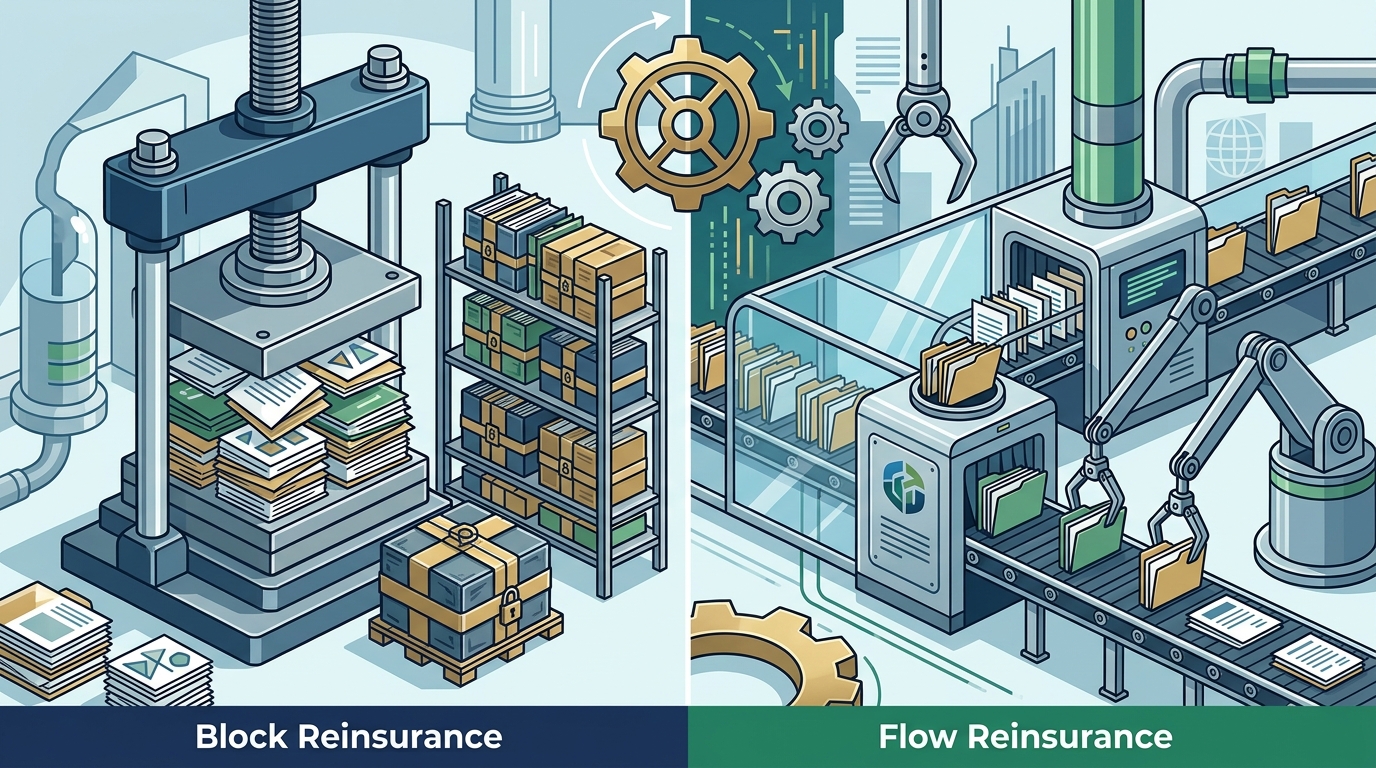
Reinsurance serves as the backbone of financial stability for insurance carriers, yet the mechanisms for delivering that stability vary significantly. Flow reinsurance is a continuous agreement that covers a defined class of new business over a specific period, allowing for scalable capacity. Block reinsurance is a transactional agreement that transfers a specific, existing portfolio of in-force policies from the ceding company to the reinsurer. The fundamental distinction lies in timing and scope. Flow reinsurance supports future growth by providing ongoing capacity, while block reinsurance addresses historical liabilities by unlocking trapped capital.
For annuity portfolios, which are characterized by long-duration liabilities and complex interest rate sensitivities, the choice between these two models dictates how an insurer manages its risk profile. Flow reinsurance integrates seamlessly with new product issuance, whereas block reinsurance is often driven by corporate restructuring, mergers and acquisitions, or the need for immediate surplus relief. Understanding the operational nuances of each is essential for making a data-driven decision that aligns with your capital objectives.
Flow Reinsurance: Strategic Growth and Scalability
Flow reinsurance is designed for insurers who are actively expanding their market share. This model provides consistent capacity for new business production, which is particularly valuable in the annuity sector where product lines such as fixed and indexed annuities require robust capital backing. By utilizing flow reinsurance, carriers can manage reserve growth while maintaining balance sheet strength and ratings stability. The structure is designed to integrate seamlessly with new issuance, allowing partners to grow confidently over time.
The primary benefit of flow reinsurance is its scalability. As an insurer writes more business, the reinsurance coverage automatically scales with it, eliminating the need for repetitive negotiations for each new policy or block of business. This efficiency is crucial for maintaining competitive pricing and speed to market. Furthermore, flow reinsurance supports fixed and indexed annuities, as well as other similar products, by providing efficient surplus relief and liability transfer. This allows the ceding company to focus on sales and distribution without being constrained by capital limitations.
However, the cost structure of flow reinsurance must be carefully analyzed. While it offers operational efficiency, the ongoing nature of the agreement means that premiums and fees are continuous. Insurers must ensure that the cost of this continuous coverage is justified by the volume of new business and the strategic value of the capital relief provided. For companies with aggressive growth targets, the benefits often outweigh the costs, as it enables them to take on more risk than their standalone capital base would allow.
Block Reinsurance: Capital Relief and Portfolio Optimization
Block reinsurance is the preferred solution for insurers looking to optimize their existing portfolios. This model is particularly effective for releasing capital from legacy liabilities. Whether driven by corporate restructuring, capital optimization, or M&A strategy, block reinsurance transactions are structured to enhance financial flexibility while maintaining transparency and regulatory integrity. The process involves a detailed analysis of the in-force portfolio, including reserve adequacy, asset allocation, and liability characteristics.
The primary advantage of block reinsurance is the immediate release of capital. By transferring the risk associated with a closed block, runoff, or acquired portfolio, insurers can unlock trapped capital that can then be redeployed into higher-yielding opportunities or used to strengthen the balance sheet. This is especially relevant in the context of closed blocks and runoff, where the future cash flows are more predictable, allowing for precise pricing and structuring. The solution is customized to fit accounting, tax, and asset strategies, ensuring that the transaction delivers maximum value to the ceding company.
Cost considerations for block reinsurance are typically front-loaded due to the complexity of the underwriting and structuring process. However, the long-term financial benefits can be substantial. By removing legacy liabilities from the balance sheet, insurers can improve their risk-adjusted returns and reduce the volatility associated with long-duration annuity products. This strategic move is often part of a broader corporate strategy to streamline operations and focus on core competencies. For insurers with aging portfolios, block reinsurance offers a path to financial clarity and stability.
Cost-Benefit Comparison: Key Metrics
When evaluating the cost-benefit analysis of block versus flow reinsurance, it is essential to look at specific operational metrics. The following table summarizes the key differences between the two approaches, highlighting the strategic implications for each.
| Criteria | Flow Reinsurance | Block Reinsurance |
|---|---|---|
| Primary Objective | Support new business growth and scalability | Release capital from legacy liabilities |
| Capital Impact | Ongoing surplus relief and reserve management | Immediate capital unlocking and balance sheet optimization |
| Operational Complexity | Lower ongoing complexity; automated integration | High initial complexity; detailed portfolio analysis |
| Strategic Fit | Aggressive growth and market expansion | Portfolio optimization and risk reduction |
| Regulatory Alignment | Designed for continuous compliance and ratings stability | Tailored to specific accounting and tax strategies |
The data shows that the choice between these models is not binary but rather dependent on the insurer's current strategic phase. Companies in a growth phase may find flow reinsurance more cost-effective due to its scalability, while those in a consolidation phase may benefit more from the capital relief offered by block reinsurance. It is also worth noting that many insurers utilize a hybrid approach, combining both models to address different aspects of their business. This dual strategy allows for comprehensive risk management and capital optimization.
Regulatory and Structural Considerations
Regulatory compliance is a critical factor in the reinsurance decision-making process. Insurers must navigate complex regulatory regimes across key global markets, including NAIC, Solvency II, and APAC frameworks. The structural integrity of the reinsurance agreement must align with these regulatory requirements to ensure that the capital relief is recognized and that the insurer maintains its financial strength ratings. For example, in the context of Solvency II, the calculation of the Solvency Capital Requirement (SCR) can be significantly impacted by the type of reinsurance used.
Furthermore, the transparency of the reinsurance structure is paramount. Insurers require clear visibility into the pricing, risk transfer, and capital impact of the agreement. This transparency is essential for maintaining trust with regulators, rating agencies, and shareholders. American Reinsurance emphasizes a collaborative approach, working as an extension of the client's team to ensure that all regulatory and structural nuances are addressed. This includes providing forward-looking insight to help clients position ahead of regulatory, interest rate, and accounting changes.
The role of data-driven analysis cannot be overstated in this context. By leveraging advanced analytics, insurers can model the long-term impact of different reinsurance structures on their balance sheet. This allows for a more accurate assessment of the cost-benefit ratio, taking into account factors such as interest rate sensitivity, mortality risk, and lapse rates. The goal is to build from first principles, leveraging analytics to design truly bespoke solutions that align with the insurer's specific risk appetite and capital structure.
Key Takeaways
- Strategic Alignment: Flow reinsurance is ideal for growth-oriented insurers, while block reinsurance suits those seeking capital relief from legacy portfolios.
- Capital Efficiency: Block reinsurance offers immediate capital unlocking, whereas flow reinsurance provides ongoing surplus relief.
- Operational Scalability: Flow reinsurance scales automatically with new business, reducing administrative burden.
- Regulatory Compliance: Both models must be structured to comply with global regulatory frameworks, including NAIC and Solvency II.
- Data-Driven Decisions: Advanced analytics are essential for modeling the long-term financial impact of reinsurance choices.
- Hybrid Approaches: Many insurers benefit from combining both models to address diverse strategic objectives.
- Long-Term Partnership: Successful reinsurance strategies are built on trust, transparency, and a focus on long-term capital efficiency.
Frequently Asked Questions
What is the primary difference between block and flow reinsurance?
Block reinsurance transfers a specific, existing portfolio of in-force policies to release capital, while flow reinsurance covers a continuous stream of new business to support growth.
Which reinsurance model is better for managing legacy liabilities?
Block reinsurance is typically more effective for managing legacy liabilities, as it allows insurers to unlock trapped capital and reduce the volatility associated with older portfolios.
How does flow reinsurance support new business growth?
Flow reinsurance provides consistent capacity for new business production, allowing insurers to write more policies without being constrained by their standalone capital base.
Are there regulatory considerations for reinsurance structures?
Yes, reinsurance structures must align with regulatory regimes such as NAIC, Solvency II, and APAC frameworks to ensure capital relief is recognized and ratings stability is maintained.
Can insurers use both block and flow reinsurance simultaneously?
Yes, many insurers use a hybrid approach, combining block and flow reinsurance to address both legacy liability management and new business growth objectives.
What role does data play in choosing a reinsurance model?
Data-driven analysis is critical for modeling the long-term financial impact of reinsurance choices, helping insurers assess cost-benefit ratios and risk exposure accurately.
How does American Reinsurance approach reinsurance structuring?
American Reinsurance builds bespoke solutions from first principles, leveraging deep expertise in actuarial science, capital markets, and regulatory frameworks to align with client goals.
Next Steps
Choosing the right reinsurance strategy is a complex decision that requires deep expertise and a clear understanding of your capital objectives. Whether you are looking to scale your new business through flow reinsurance or optimize your legacy portfolio with block reinsurance, the right partner can make all the difference. American Reinsurance offers tailored, capital-backed solutions that empower insurers to grow with confidence. We combine financial strength, regulatory expertise, and a deep understanding of your business to deliver precision pricing and strategic alignment.
Do not rely on templates. We build reinsurance around your objectives. Contact our team today to discuss a capital-efficient, custom-fit solution for your business. Visit our Contact Us page to schedule a consultation with our senior management team. Learn more about our Reinsurance Solutions and how we can help you navigate the complexities of the modern insurance market. Explore our About Us page to understand our commitment to reliability, transparency, and long-term partnership.